
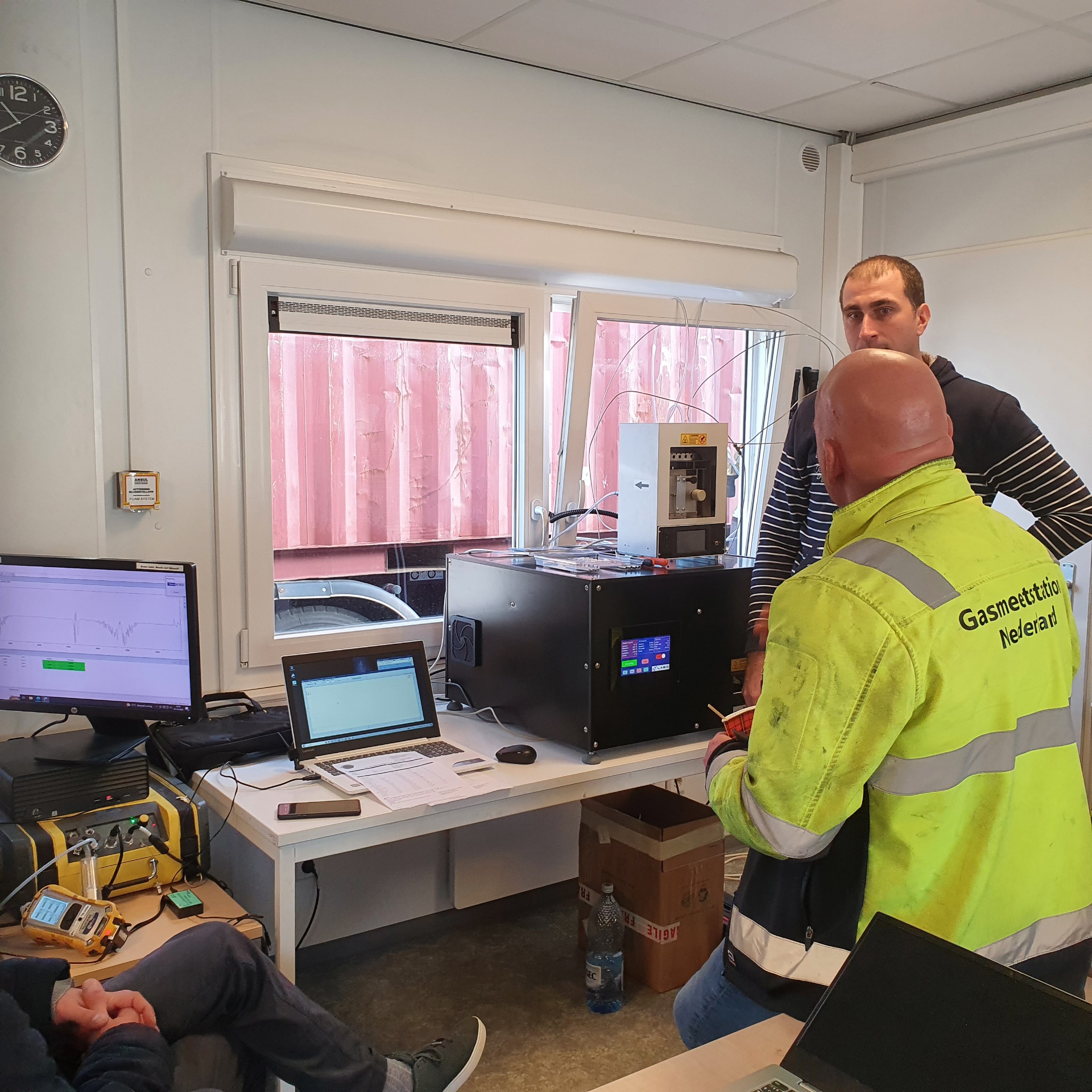
The container had been sitting in the yard for three days. The shipping manifest said "agricultural goods." The handheld monitor said "VOC: high." Nobody wanted to open the doors — and nobody wanted to send it back without knowing what was inside.
Why a handheld is not enough
The scale of the problem is not anecdotal. An independent Chalmers University of Technology study, built on operational gas-measurement records from Gasmeetstation Nederland, found that approximately 30% of inspected sea-freight containers contained elevated concentrations of one or more potentially toxic or carcinogenic VOCs at the moment of first opening — and that the majority of those compounds originated from in-transit cargo off-gassing rather than from declared fumigation.[1] That single finding reframes the job: a fumigation manifest is not a safety clearance.
Container terminals at the Port of Rotterdam handle more than fourteen million TEU a year. A small but persistent fraction of those containers arrive with hazardous atmospheres inside: residual fumigants such as phosphine (PH₃), methyl bromide (CH₃Br), 1,2-dichloroethane, formaldehyde, benzene, and a long tail of industrial off-gases that desorb from cargo, packaging, glues, and treated wood.
Surveyors from Gasmeetstation Nederland are the people called in to make the safe-to-open decision. Their existing toolkit — electrochemical sensors, photoionisation detectors (PIDs), and colorimetric detection tubes — is fast, but it has two well-known limits:
- PIDs report a single sum signal. A reading of 40 ppm "VOC" tells you something is there. It does not tell you whether it is ethanol from spilled hand sanitiser or 1,2-dichloroethane from a degraded solvent drum.
- Detection tubes are compound-specific. You only find what you already suspected. Unknown fumigants slip through.
When a tube comes back inconclusive, the standard fallback is a Tedlar bag, a courier, and a 24- to 72-hour wait for a remote GC-MS lab. In a working terminal, that delay cost is measured in demurrage fees and blocked berths.
Why GC-UV — and why on-site
The collaboration with Gasmeetstation Nederland started from a simple question: could we replace the courier with an instrument that lives in the survey vehicle? The constraints were unforgiving. It had to identify dozens of regulated fumigants and VOCs in a single run, separate isomers that GC-MS routinely confuses, run on nitrogen carrier gas (helium logistics in a port environment are painful), tolerate vibration and temperature swings, and produce a result a non-chemist surveyor could act on.
INSCAN's vacuum-UV detector, with usable response from below 155 nm up to 330 nm, was the right physical match. Almost every molecule of interest in container atmospheres has a strong electronic absorption in that window — including the ones that are nearly silent on GC-MS, like phosphine and the smaller halogenated compounds. Vapor-phase UV spectra are also distinctive enough to resolve structural isomers (think 1,2- vs 1,3- vs 1,4-dichlorobenzene) that share an EI mass spectrum.
The method, in plain terms
Over roughly four months of joint work — two of them on-site in Rotterdam, in the cabin you see in the photo above — we converged on a method with four moving parts.
1. Sampling
Containers are sampled through the door seal using a non-reactive PTFE probe and a calibrated diaphragm pump. We compared two front-end approaches: direct gas-loop injection for the volatile fraction, and short-bed thermal-desorption tubes (Tenax TA / Carbograph) for the semi-volatiles and the trace fumigants that need preconcentration. Both feed the same INSCAN injector.
2. Separation
A mid-polarity capillary column with a 30 m × 0.32 mm × 1.0 µm phase gave a workable compromise: phosphine and methyl bromide elute cleanly early in the run, while the chlorinated solvents and aromatics resolve in the middle, with formaldehyde and the heavier fumigants tailing in. Total runtime sits around 9 minutes, which is what makes the on-site workflow viable.
3. Detection
INSCAN acquires a full UV spectrum at every chromatographic time-point. That is the part that does the heavy lifting. Each peak is identified by combining retention time with a library-matched absorbance spectrum from our co-built reference library — currently 84 compounds relevant to container fumigation and industrial cargo off-gassing. The match score, not the operator's pattern recognition, makes the call.
4. Verdict
The output the surveyor actually sees is a one-page summary: each detected compound, its concentration estimate against the relevant occupational limit (TWA / STEL / IDLH), and a single colour-coded verdict — safe to open, ventilate first, or do not enter, escalate. The chromatogram and spectra are kept on file for traceability.
What we found in the field
Across the validation campaign in Rotterdam, the joint method ran on 312 containers spanning consumer goods, agricultural cargo, industrial chemicals, and used machinery. A few patterns stood out:
- Roughly 11% of containers carried at least one regulated compound above its 8-hour occupational exposure limit at the moment the door was first cracked.
- In the subset previously cleared by handheld PID alone, the GC-UV method flagged 4 additional compounds on average per container — including isomer-specific identifications that the on-site GC-MS comparator had reported only as a generic "C₂H₄Cl₂."
- Phosphine — the workhorse fumigant for grain shipments and one of the harder molecules to catch on GC-MS — was identified down to ~30 ppb in the integrated workflow, well under the 0.1 ppm Dutch occupational limit.
What changed for the surveyor
The honest answer is: the conversation at the container door changed. The surveyor no longer has to choose between a fast-but-vague PID number and a slow-but-defensible lab report. They get a defensible answer in under fifteen minutes from the moment the probe goes in, with a printable record that holds up in a follow-up audit.
From our side, the project did something equally important. It pushed INSCAN out of the temperature-controlled lab and into a vehicle parked next to a working berth, in October, in the rain. Several of the ruggedisation choices that ended up in the current INSCAN production firmware — the autotune routine that compensates for cabin temperature drift, the simplified one-button "field run" mode, the offline library sync — came directly from sitting in that cabin and watching what actually got used.
What is next
We are now extending the joint reference library to cover a second tier of cargo types: lithium-battery off-gas products, refrigerant leaks from reefer containers, and the breakdown markers from heat-damaged goods. The same INSCAN platform handles all of them; only the library and the verdict thresholds change.
If you operate a terminal, a customs lab, or an emergency-response unit and you are hitting the same wall — fast handhelds that don't identify, slow labs that don't scale — we'd like to talk. The Rotterdam method is portable, and most of the work to adapt it to a new port is library curation, not hardware.
- Brännhammar, C., & Främme, M. (2023). Identification and categorisation of toxic chemical gases in shipping containers [Bachelor's thesis, Chalmers University of Technology]. Chalmers Open Digital Repository. https://hdl.handle.net/20.500.12380/307286 · Read summary
With thanks to the surveyor team at Gasmeetstation Nederland in Rotterdam for the access, the patience, and the brutally honest feedback over four months of joint fieldwork.